
Glute Training:Not Just About Looks.
- Team PhysioQinesis : Credit Samiksha Shetty
- 9 hours ago
- 3 min read
Your glutes are the most underrated muscle group in your body. Not because of how they look — but because of everything they’re quietly holding together.
01 They Do More Than You Think
Three muscles. Three jobs. All essential.
• Glute Max: Your engine. Every sprint, jump, squat, and stair climb runs through here. Walking doesn’t load it enough — which is why most people’s biggest muscle is also their weakest.
• Glute Med: Your stabiliser. Keeps the pelvis level and the knee in line with every step. When it’s not working, the knee collapses inward and the back picks up the slack.
• Glute Min: Your deep anchor. Keeps the hip joint stable. Most people have never trained it. Many people have lateral hip pain because of it.
When they work together: you move well, feel strong, and stay pain-free. When they don’t: your body compensates — and something else breaks down.

02 Weak Glutes Don’t Just Hurt Your Glutes
This is the part most people miss. Gluteal weakness rarely shows up as ‘glute pain.’ It shows up as:
• Knee pain on stairs or during runs
• Lower back ache after long days on your feet
• Hamstrings that are ‘always tight’ no matter how much you stretch
• Hip pain on the outer side that doesn’t resolve
• Balance that feels off, especially on one leg
“The problem isn’t always where the pain is. Weak glutes are one of the most consistent upstream causes of lower limb and back pain we see in the clinic.”
— Physioqinesis Clinical Team

03 The Science Is Clear
This isn’t gym folklore. The research on glute training is now substantial — and the findings go well beyond aesthetics.
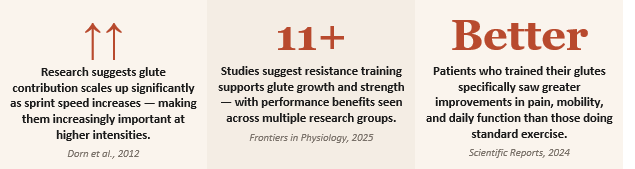
That last one matters. People with chronic lower back pain who trained their glutes got better results across pain, mobility, and daily function than those doing standard exercise. Glute training wasn’t a nice add-on. For many people, it’s a significant part of what makes the difference.

04 Training Them Right
Clamshells and banded bridges have a place — they’re great for switching the muscle back on. But they are not enough to build the strength your body needs. Real glute training means progressive load in real movement patterns:
• Hip thrusts: Best exercise for isolating the glute max. Directly linked to sprint and jump performance gains.
• Deep squats: Depth is everything. Full squats produce significantly more glute activation than half squats.
• Step-ups: One of the hardest-working glute exercises you can do. Simple, loadable, and brutally effective.
• Single-leg RDL: The only exercise ranked top-tier for all three glute muscles simultaneously. The most efficient glute exercise that exists.
• Side plank: Bodyweight but top-ranked for the glute med and min. Non-negotiable for hip and knee health.
The common mistake? Chasing the burn. What actually matters is: Can you move better? Can you load more over time? Is the pain reducing? Those are the signs the work is real.

05 So Where Do You Start?
Not every sore knee or tight back needs the same fix. That’s why we assess first — figuring out which muscle is the weak link, what’s compensating for it, and what your body actually needs. From there, the exercises make sense, the progression feels logical, and results tend to follow.
Whether you’re dealing with pain, coming back from injury, or just want to move and feel better — glute training is almost always part of the answer.
Move better. Hurt less. Feel stronger.
That’s what well-trained glutes can do for you. The aesthetics? A welcome side effect.


Comments