
FORCE PLATE TESTING FOR ATHLETES : MEASURING PERFORMANCE AND PREVENTING INJUIRES
- Team PhysioQinesis: Credit Taher Kudrati
- Jan 8
- 3 min read
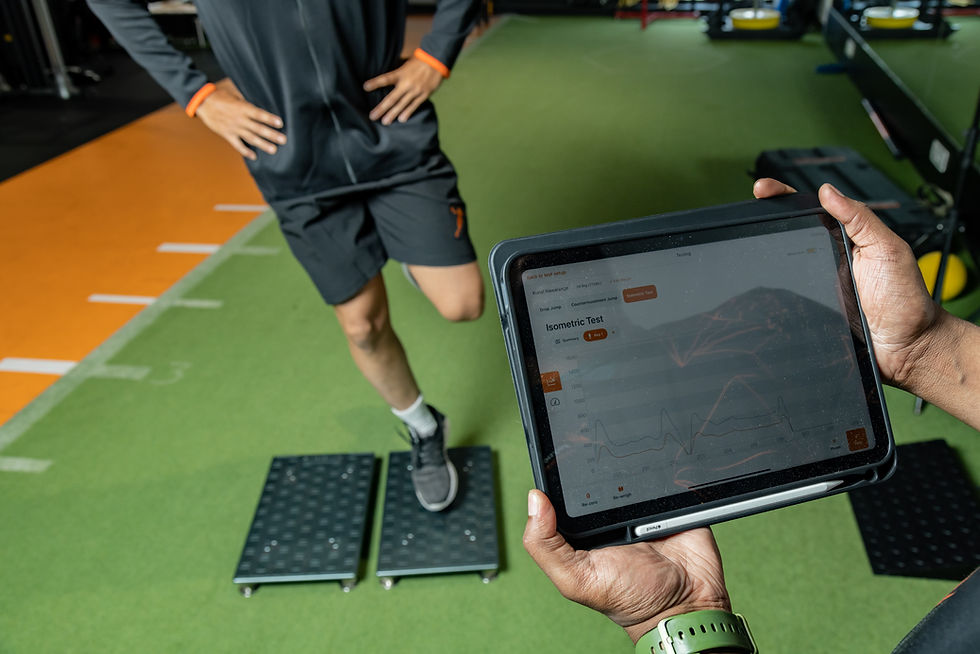
In sports science, numbers don’t lie and that’s the whole point of using force plates. They let us go much deeper than what the eye can see. Instead of guessing how well an athlete jumps, lands, absorbs force, or produces power, force plates tell us exactly what’s happening with every movement. When we understand what we’re testing, why we’re doing it, and how each test guides training, the data becomes far more meaningful than just “doing a jump test.”
Force plates capture things like peak force, power, jump height, rate of force development, landing control, braking impulse, and asymmetries. Each test teaches us something different. A squat jump shows raw concentric force, how much power you can produce from a dead stop without using any stored elastic energy. A countermovement jump tells us how efficiently your body uses the stretch shortening cycle, which is basically how well your muscles and tendons store and release elastic energy.
Drop jumps show reactive strength and how quickly you can turn a landing into a take off. Single leg landings and hops highlight unilateral control and side to side differences. Isometric tests, like the mid thigh pull or the isometric squat, show your maximum strength and how quickly you can produce force. And upper body isometrics, like the IYT test, reveal how strong and stable your shoulders and scapular muscles are, crucial for anyone who throws, serves, or works overhead.
The reason we run all these tests is simple: these qualities predict performance and injury risk. Athletes with better concentric power usually accelerate faster and jump higher. A typical squat jump for a trained male athlete is somewhere around 28-35 cm, and elite athletes can push above 40 cm. In the countermovement jump, trained athletes usually hit around 35-45 cm, while elite performers cross 50-60 cm. If we see big differences between legs, usually anything above 8-12%, that’s a sign we need to address the imbalance. The drop jump gives us RSI, which tells us how reactive and bouncy an athlete is. Most field and court athletes sit around 2.0-3.0, and top-level players go 3.5 and above. Lower RSI means poorer tendon stiffness and slower ground contacts, which also increases injury risk.
Single-leg tests give us some of the most important information because sport rarely happens on two legs. When an athlete lands or jumps on one leg, we can clearly see if one side handles force differently. Ideally, asymmetries should stay under 10%. Anything above 15% is strongly linked with ACL injuries, patellofemoral pain, and ankle instability. Lateral hop tests add another layer by showing how well you produce and control sideways forces, something most athletes don’t train enough. Weakness in muscles like the gluteus medius, adductors, or lateral core often shows up here, and these weaknesses are a big reason for groin issues, hip drops, and poor change of direction mechanics.
Isometric strength tests help us confirm whether an athlete actually has the strength needed for their sport. In the mid thigh pull, well trained athletes typically produce 18-35 N/kg, and elite strength/power athletes go above 40 N/kg. Just as important is the rate of force development, if you’re slow to produce force, you’re also more likely to overload tissues during fast movements. The isometric squat reveals hidden asymmetries that don’t show up in dynamic exercises, and the IYT test shows shoulder force output, which is key for reducing rotator-cuff overload and improving overhead mechanics.
All of these tests also help massively with injury prevention. Force plates pick up imbalances before they cause knee or ankle injuries, they show us if landing mechanics are safe or risky, they help us understand fatigue patterns so we don’t push athletes too far, and they make return to sport decisions far more accurate. Instead of guessing whether an athlete is ready, we compare their current numbers to their normative values and their own previous data. When we put everything together, force plate testing gives a complete picture of how an athlete moves, where they’re strong, where they need work, and how we can keep them performing at a high level without breaking down.


Comments